
VR16 CPU 🔗
08-04-2025
GitHub repository: link
Docs up-to-date with: 82f862f
Updated on: 20-03-2026.
This is a simple 16-bit RISC CPU built from scratch. This is the full-on documentation for the VR16 CPU (which is the name for it).
VR16 runs on it’s own instruction set called VR16-ISA.
This is not a RISC-V CPU, but a RISC one.
Specifications 🔗
The following mention the specifications of VR16:
- single-stage, multi-cycle cpu
- 16-bit cpu (this is the 2nd time I’ve mentioned that lol)
- has 4 general purpose registers (r0, r1, r2, r3)
- supports immediate values.
- supports conditional and unconditional branching.
Documentation Links 🔗
Setup 🔗
How to run this project on your local machine.
Python environment 🔗
This is required for assembler/compiler and the helper scripts. Tested with Python 3.10 to 3.12.
Create and activate a virtual environment from the repo root:
$ python3 -m venv .venv
$ source .venv/bin/activate
$ pip install -r requirements.txt
RTL simulation prerequisites 🔗
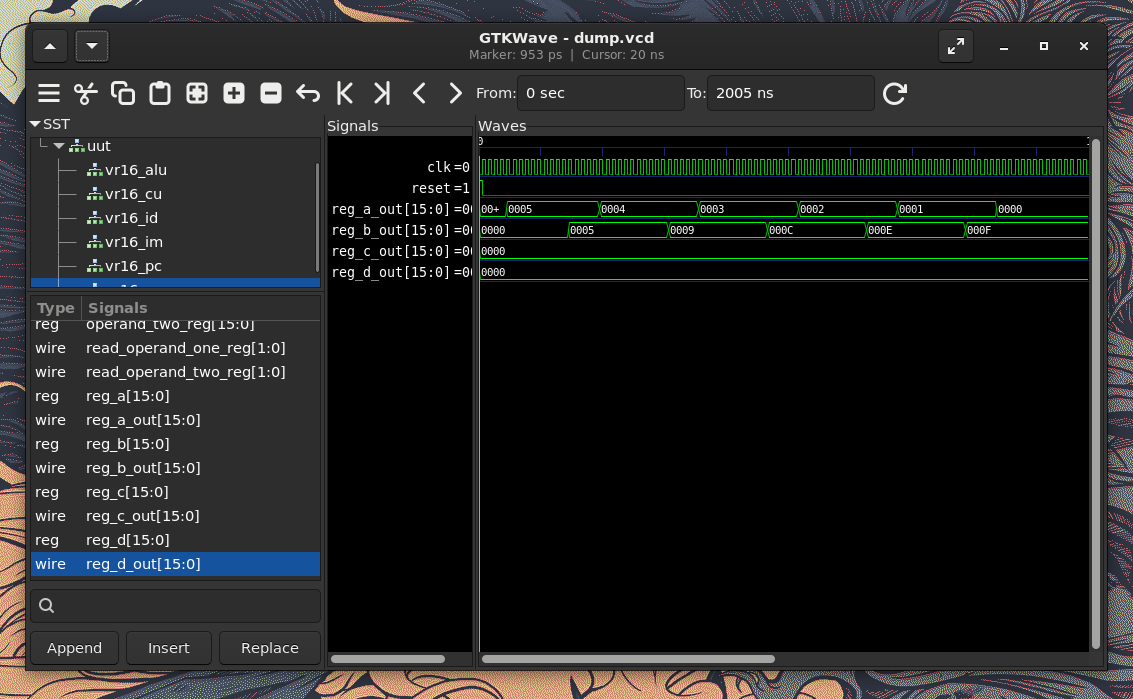
Install the simulator + waveform viewer:
iveriloggtkwave
Then run:
$ ./compile.sh
$ ./sim.sh
Assembler/Compiler-only usage (no RTL simulation) 🔗
If you only want to use the toolchain (VRASM / VRScript), you only need the Python setup above (virtual environment + pip install -r requirements.txt).
iverilog and gtkwave are not required unless you plan to run ./compile.sh / ./sim.sh.
Verification 🔗
Python testbench checks 🔗
Frontend Python testbench regressions live under src/frontend/tb/test_*.py and are expected to be run with pytest from the repository root:
$ pytest src/frontend/tb/test_*.py
RTL simulation checks 🔗
For RTL flow validation, run the simulation scripts in order:
$ ./compile.sh
$ ./sim.sh
Roadmap 🔗
- Finish basic RTL.
- Finish toolchain:
- assembler (only have to implement pseudo instructions)
- compiler
- Physical design to generate GDSII file for tapeout.
Misc. 🔗
The below list out all the dev-blogs I’ve written while developing this:
-
FPGA Implementation - Apr 06, 2026
-
RTL is complete! - Mar 20, 2026
-
VR16 Update - Jul 02, 2025
-
VR16 - ALU I HATE YOU!!!! - Apr 02, 2025
-
VR16 Devblog 1 - Mar 28, 2025